

From industrial wasteland to wildlife haven, one Cheshire wetland is giving one of Britain’s rarest breeding birds a remarkable comeback
A patch of land once used to hold dredged material from the Manchester Ship Canal has undergone an extraordinary transformation — and some rather glamorous new residents have moved in.
Woolston Eyes, near Warrington in Cheshire, has become the most important breeding site in Britain for the striking black-necked grebe.
And the numbers tell quite a story.
In 2023, just four pairs bred in a newly restored section of the reserve. By 2025, Woolston Eyes recorded a remarkable 35 breeding pairs — with 29 of them choosing the restored wetland. According to the RSPB, that means the reserve supported around 64% of the UK’s average breeding population of black-necked grebes.
From wasteland to wetland
It is a remarkable turnaround for somewhere with such an industrial past.
The Woolston Eyes site consists of former deposit grounds for dredgings from the Manchester Ship Canal. Today, the nature reserve is a Site of Special Scientific Interest and contains around 400 hectares of freshwater pools, reedbeds, willow scrub and rough vegetation.
But creating the right home for the grebes required more than simply leaving nature alone.
In 2021, the RSPB and Woolston Eyes Conservation Group began restoring an area where wetland had dried out and willow scrub and invasive plants had taken over. Vegetation was cleared, nutrient-rich topsoil was removed and reused to form embankments, and two shallow wetland areas and nesting islands were created.
There was even some clever matchmaking involved — although not quite between the grebes themselves.
Good neighbours
The new islands were designed partly to encourage black-headed gulls to nest.
That might sound like an odd way to help another bird, but black-necked grebes frequently nest close to gull colonies. The gulls aggressively defend their own nests from predators, effectively providing the much smaller grebes with an extra layer of security.
The plan worked.
Four pairs of black-necked grebes bred in the restored habitat in 2023 and raised 15 young. Two years later, the reserve recorded those 35 breeding pairs.
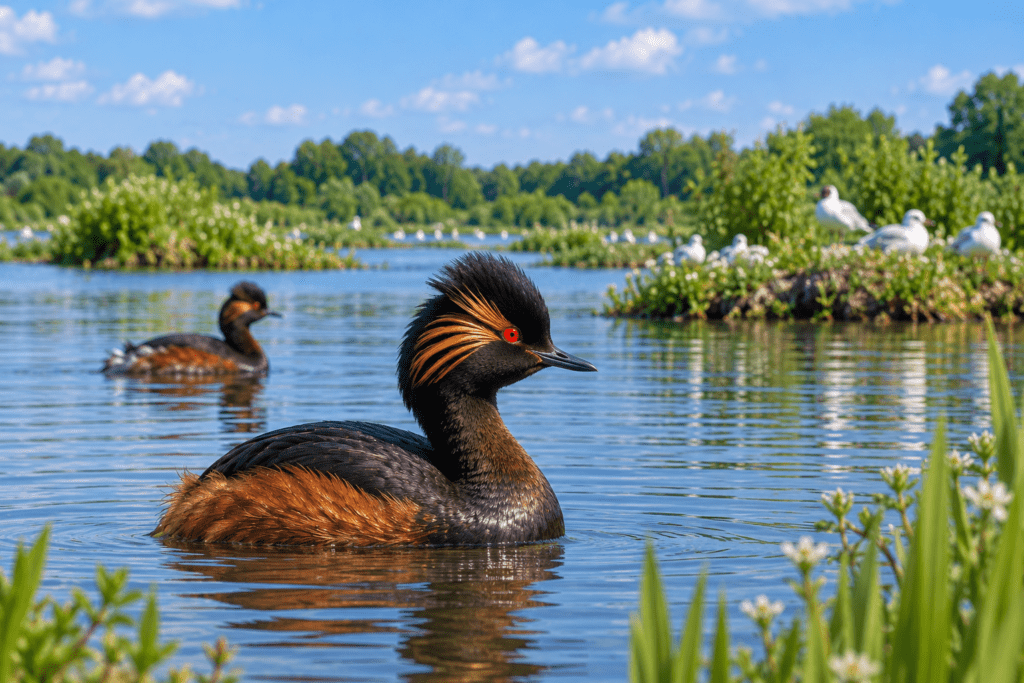
They’re difficult birds to overlook when you do get the chance to see one. In breeding plumage, black-necked grebes have dark heads, chestnut bodies, brilliant red eyes and spectacular fans of golden feathers behind their eyes.
Their courtship is equally impressive. Pairs perform an elaborate display in which they swim together, mirror one another’s movements and eventually rise breast-to-breast from the water before building their floating nest among the vegetation.
Nature gets another chance
The transformation is benefiting far more than one species.
Woolston Eyes is also an important home for wildlife including willow tits, pochards and grasshopper warblers, while the restored pools and surrounding vegetation provide valuable habitat for a much wider range of wetland life.
And the success hasn’t stopped there. During an April 2025 Wetland Birds Survey, conservationists counted a record 62 black-necked grebes at the reserve.
There are still challenges. Wetlands are particularly vulnerable to prolonged dry weather, and Woolston Eyes relies on rainfall. Water levels therefore have to be carefully managed to keep suitable habitat available.
But for a landscape that began life as somewhere to put material dredged from an industrial shipping canal, its transformation is difficult to miss.
Where there was once spoil and wasteland, there are now pools, reedbeds, nesting islands — and one of Britain’s rarest breeding birds raising its young.
Sometimes giving nature somewhere to come back to is all it needs.








Add comment
You must be logged in to post a comment.