

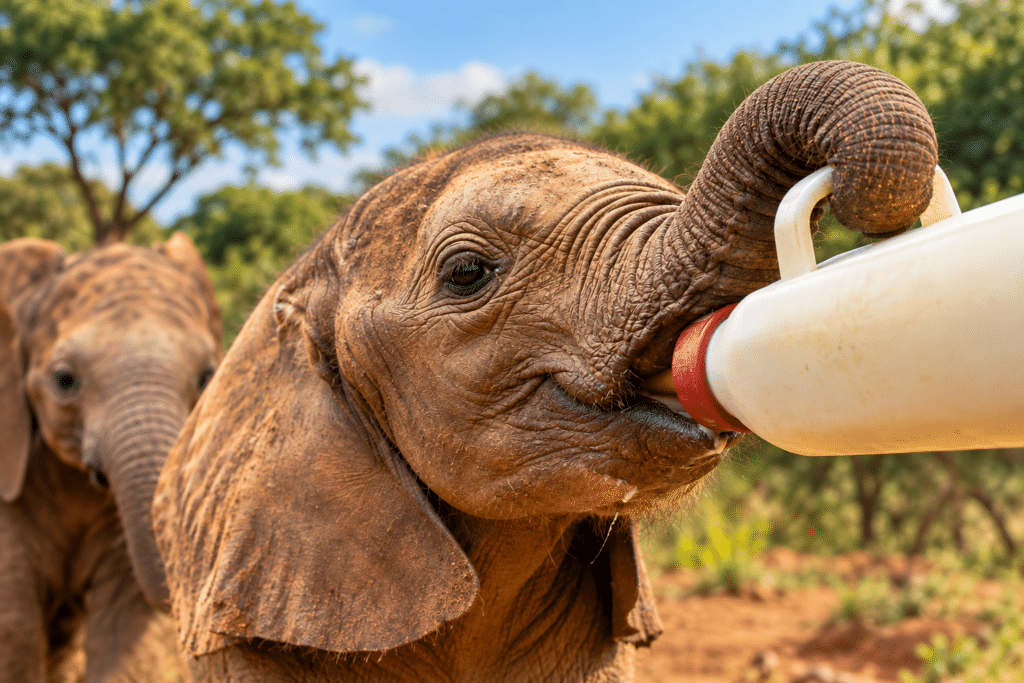
A tiny elephant survived lions, violent storms and weeks alone in the African wilderness. Now Bungalu has beaten the odds — and found himself a new family.
At just ten months old, Bungalu had already faced more than most elephants will encounter in a lifetime.
When reports began coming in of a lone elephant calf wandering around Bungule, near the foothills of Mount Kasigau in southern Kenya, rescuers knew something was wrong.
A calf that young should have been surrounded by his mother and herd. Instead, Bungalu was completely alone.
Teams from the Sheldrick Wildlife Trust and Kenya Wildlife Service began searching for him, but the frightened youngster proved remarkably good at disappearing into the bush.
On 27 February, rescuers finally thought they had him.
A helicopter raced to the area after the local community spotted the increasingly thin calf — only for Bungalu to bolt moments before help arrived.
Teams searched from the air and on the ground, following his tracks across farmland, but once again he vanished.
Then the weather turned.
A ferocious storm swept across the Tsavo region, bringing torrential rain, thunder and lightning. For a young elephant already struggling without his mother’s milk or the protection of a herd, his chances of survival seemed increasingly slim.
But Bungalu wasn’t finished yet.
Two days later, on 1 March, two local Maasai men spotted the little elephant emerging from hiding. This time, the community made sure he couldn’t disappear again while rescuers raced back to collect him.
Only after Bungalu arrived safely at the Sheldrick Wildlife Trust’s Kaluku Unit did his extraordinary story begin to reveal itself.
Across his back were deep, healed claw marks.
Bungalu had survived a lion attack.
Rescuers believe the encounter may have been what separated him from his herd in the first place. Judging by the number of scars across his body, he was extraordinarily fortunate to have escaped.
And the weeks spent alone had taken their toll.
Bungalu was painfully thin, riddled with parasites and suffering from bleeding ulcers. At an age when he should still have been dependent on his mother’s milk, he had been trying to survive by finding whatever food he could.
The ordeal had affected him emotionally too. During his first weeks in safety, Bungalu barely slept, instead rocking at the back of his stable and grabbing only a few minutes of rest at a time.
He had spent so long surviving on his own that remaining constantly alert had become normal.
Yet something remarkable happened.
Rather than retreating from his rescuers, Bungalu embraced them.
By his very first night, he was drinking milk from a bottle and suckling his keepers’ fingers. Slowly, with food, veterinary care and plenty of attention, the little elephant who had arrived as little more than skin and bone began to recover.
And then came Kaikai.
Another orphaned elephant being cared for at Kaluku, Kaikai became Bungalu’s new companion — although the two couldn’t be more different.
Kaikai is energetic, confident and decidedly bossy. Bungalu is the calmer of the pair, usually content to amble along behind her and let his new friend take charge.
Usually.
When Kaikai gets a little too bossy, Bungalu has been known to remind her who’s there with a well-timed headbutt.
Six months after his rescue, Bungalu is now around 16 months old and continuing to recover.
He’s even developed an endearing trick at feeding time. African elephants have two prehensile “fingers” at the tip of their trunks, and Bungalu carefully uses his to grasp the handle of his milk bottle.
He’s not quite strong enough to hold the bottle himself yet.
But, after everything Bungalu has already overcome, you probably wouldn’t bet against him.
From facing lions and thunderstorms alone in the Kenyan wilderness to milk bottles, keepers and a bossy new best friend, Bungalu’s life looks very different today.
The scars across his back haven’t disappeared.
But neither did Bungalu.
And this little elephant has finally got a herd around him again.






Add comment
You must be logged in to post a comment.