
Bristol Puts the Brakes on High-Carbon Advertising
Bristol has decided that if it is working towards a cleaner, greener future, its own advertising spaces should not be encouraging people to buy some of the products associated with higher carbon emissions.
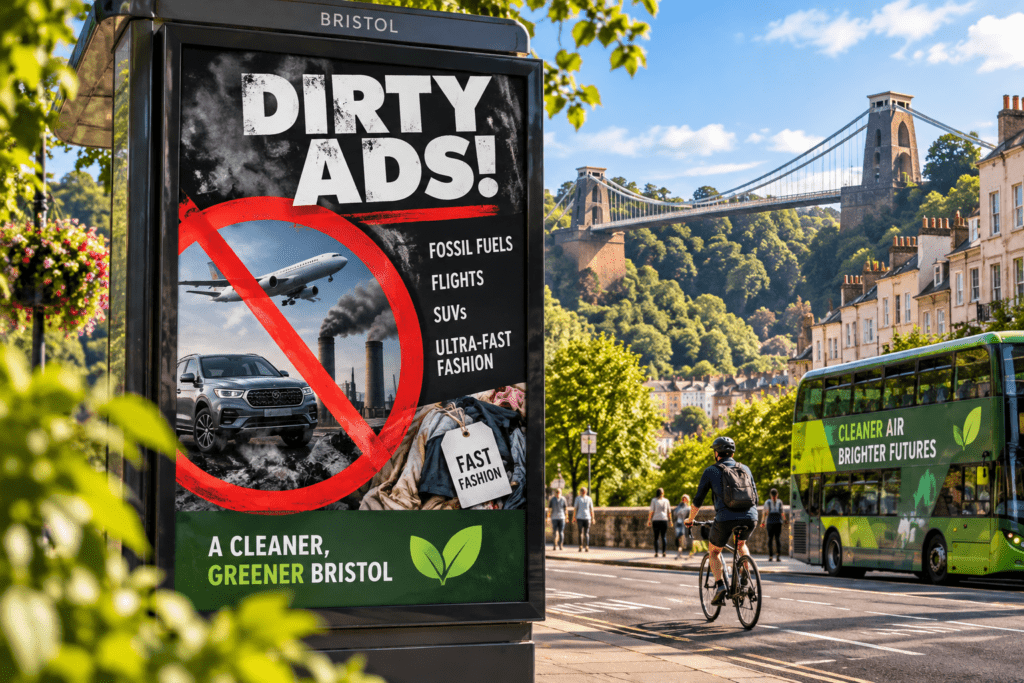
The city has introduced new restrictions on high-carbon advertising across council-controlled sites, including bus shelters, billboards and some digital displays. The updated policy was approved by Bristol City Council’s Strategy and Resources Committee by eight votes to one.
Under the new rules, adverts promoting petrol, diesel and hybrid vehicles will be restricted, along with SUVs, flights, airports, cruise holidays, travel agents and companies involved in the fossil-fuel industry.
But Bristol has gone a step further.
A UK First for Fast Fashion
The city has become the first UK council to introduce advertising restrictions specifically targeting the excessive consumption of fast fashion.
That includes marketing tactics designed to encourage people to keep buying more clothes, such as flash sales, stock or time-limited offers and Black Friday promotions.
The idea is straightforward: if public authorities are trying to reduce carbon emissions and improve the local environment, supporters of the policy argue that council-owned spaces should not simultaneously be used to promote high-carbon consumption.
Deputy council leader Heather Mack said Bristol did not want to become a “billboard for polluters” while the city was working to improve health, air quality and nature.
Bristol Isn’t Alone
Bristol is part of a much wider movement.
More than 20 UK councils have already introduced restrictions on advertising for polluting products and services, with cities including Sheffield and Edinburgh adopting similar policies. Bristol’s inclusion of fast-fashion advertising, however, takes the approach into new territory.
It also isn’t Bristol’s first experiment with changing what appears on council advertising sites.
The city introduced restrictions in 2021 covering advertising for products including unhealthy food, alcohol, gambling and payday loans. Research published this year found that exposure to the restricted categories on council-owned Bristol bus shelters fell substantially following implementation, although researchers did not find a measurable change in purchasing or consumption.
What the Ban Doesn’t Do
There is an important distinction.
Bristol hasn’t banned people from flying, buying an SUV or shopping for fast fashion. Nor has it prohibited those industries from advertising everywhere in the city.
The policy concerns advertising space controlled by the council. Privately owned advertising sites remain outside its scope.
That makes this less about telling Bristol residents what they can buy and more about deciding what the council itself is prepared to promote on the spaces it controls.
A Cleaner Message for the City
Advertising may seem like a small piece of the environmental puzzle, but Bristol’s decision raises an interesting question: should publicly controlled spaces promote products that conflict with a city’s environmental objectives?
Bristol has decided that, on its own advertising sites, the answer should increasingly be no.
And while removing a billboard won’t solve climate change, it does mean that the next advert somebody sees while waiting for a Bristol bus might be selling them something rather less dirty.
Sometimes positive change begins simply by changing the message.







Add comment
You must be logged in to post a comment.