

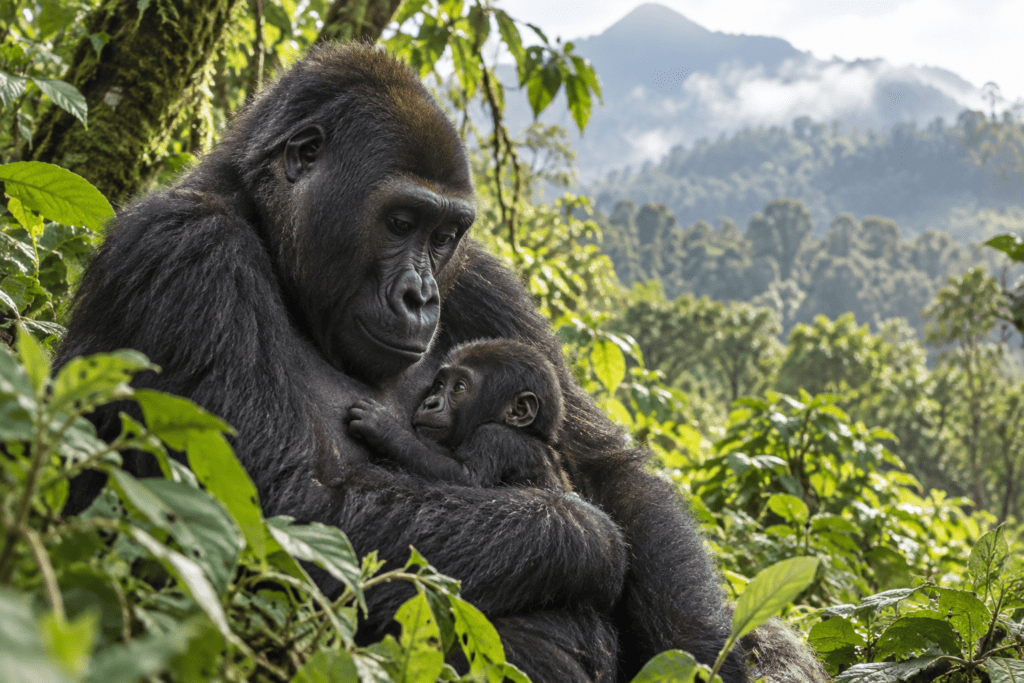
Rescued from the illegal wildlife trade as a baby, Lulingu has completed an extraordinary journey back to the forest — and now she has a baby of her own
Ten years ago, Lulingu was an 18-month-old orphan whose future looked desperately uncertain.
Today, she is living wild in the forests of the Democratic Republic of the Congo, cradling a tiny baby of her own.
It is difficult to imagine a more complete turnaround.
Lulingu is a Grauer’s gorilla — also known as an eastern lowland gorilla — and her story began in 2016, when she was rescued by the Congolese wildlife authorities and Gorilla Doctors after being taken from her family for the illegal wildlife trade.
At just 18 months old, she was the youngest orphaned gorilla ever brought to the Gorilla Rehabilitation and Conservation Education Center, better known as GRACE.
A frightened baby needed a family
Lulingu initially needed round-the-clock human care.
GRACE caregivers Devotte Kavira Kihira and Kambale Muviri fed and comforted the youngster while she recovered, but the aim was never simply to keep her alive.
A gorilla needed to teach Lulingu how to be a gorilla.
That job fell to Pinga, an experienced female at the sanctuary.
When the two were introduced, Pinga immediately took the little orphan into her care. She became Lulingu’s surrogate mother, giving her something human caregivers could never completely replace: a gorilla family.
Growing up within that group allowed Lulingu to develop the social relationships and natural behaviours she would need as an adult.
Her independent streak appeared early. On her first day in GRACE’s forest habitat, the youngster climbed a tree and built her own nest. Over the years she became increasingly confident, strong and capable in the forest.
But behind everything her carers were doing lay an extraordinary ambition.
Could Lulingu one day go home?
Preparing for something that had never been done
Returning a sanctuary-raised gorilla to the wild isn’t a matter of simply opening a gate.
For more than five years, conservationists worked towards reintroducing rescued Grauer’s gorillas to Mt Tshiaberimu, part of Virunga National Park.
The stakes went far beyond the futures of four individual animals.
The mountain holds a small and isolated population of Grauer’s gorillas. The species is critically endangered, so introducing healthy females capable of joining the remaining wild population could contribute to its long-term survival.
Lulingu’s age, strength, social behaviour, curiosity and independence made her a promising candidate.
Alongside her were three other rescued females she knew from GRACE — Isangi, Mapendo and Ndjingala.
In late 2024, the four were moved from the sanctuary to Mt Tshiaberimu.
Then, on 3 December, something extraordinary happened.
The females voluntarily left the rewilding facility and followed Mwasa, a wild silverback, into the forest.
For the first time, gorillas from GRACE had returned to life in the wild.
Lulingu was home
Leaving the facility was one milestone. Actually becoming part of a functioning wild gorilla family was another.
All four females joined Mwasa’s group.
Monitoring teams watched as they foraged, rested, groomed one another and travelled through the forest — precisely the ordinary behaviours that represented an extraordinary success for animals that had once been victims of wildlife trafficking.
Then came another encouraging observation.
Mwasa and Lulingu were seen mating.
And on 21 May 2026, the decade-long story acquired a completely new chapter.
Lulingu had given birth.
The father was Mwasa.
The tiny female wasn’t simply a baby born to a critically endangered gorilla. Her arrival showed that a youngster once removed from the wild, rescued, rehabilitated and eventually reintroduced had integrated sufficiently into a wild gorilla group to reproduce and begin raising the next generation.
Now Lulingu is the mum
There is a particularly lovely symmetry to what happened next.
Years earlier, Pinga had held and protected Lulingu when she was the vulnerable baby needing a mother.
Now monitoring teams have watched Lulingu doing much the same for her own infant — nursing her, cradling her and playing with her in the forest.
Both mother and baby are reported to be healthy.
Gorilla Doctors also reported that none of the four reintroduced females had required veterinary treatment for illness or injury since their return to the wild.
Conservationists are nevertheless being appropriately cautious. Raising an infant in the wild carries risks even for experienced gorilla mothers, and Lulingu is doing it for the first time.
But every healthy youngster matters enormously to such a small, isolated population.
And this particular youngster represents something else as well.
She is evidence of what can happen when wildlife rescue doesn’t end with rescue.
It took Congolese wildlife authorities, veterinarians, carers, scientists, local communities and conservation organisations years of work to take Lulingu from frightened orphan to an animal capable of choosing to walk back into the forest.
The project has involved GRACE, Virunga National Park, local communities, Gorilla Doctors, Re:wild and the Congolese Institute for Nature Conservation, among others.
Full circle
For the people who cared for Lulingu as a baby, seeing her become a mother has understandably been emotional.
Devotte, one of the caregivers who looked after her during those earliest days, said that learning of the birth made her feel like a grandmother.
And perhaps that is what makes Lulingu’s story such a good one.
This isn’t simply the birth of an adorable baby gorilla.
It’s the culmination of ten years of work.
A baby who lost her family was given another one.
A gorilla taken from the wild was taught the skills she needed to return to it.
An orphan became a member of a wild family.
And now that orphan is a mother herself.
For a critically endangered species, one new baby cannot solve everything.
But on a forested mountain in the Democratic Republic of the Congo, there is now one more Grauer’s gorilla than there was before — born in the wild to a mother whom, ten years ago, nobody could have known would ever make it home.
The wild child now has a wild child of her own.





Add comment
You must be logged in to post a comment.