

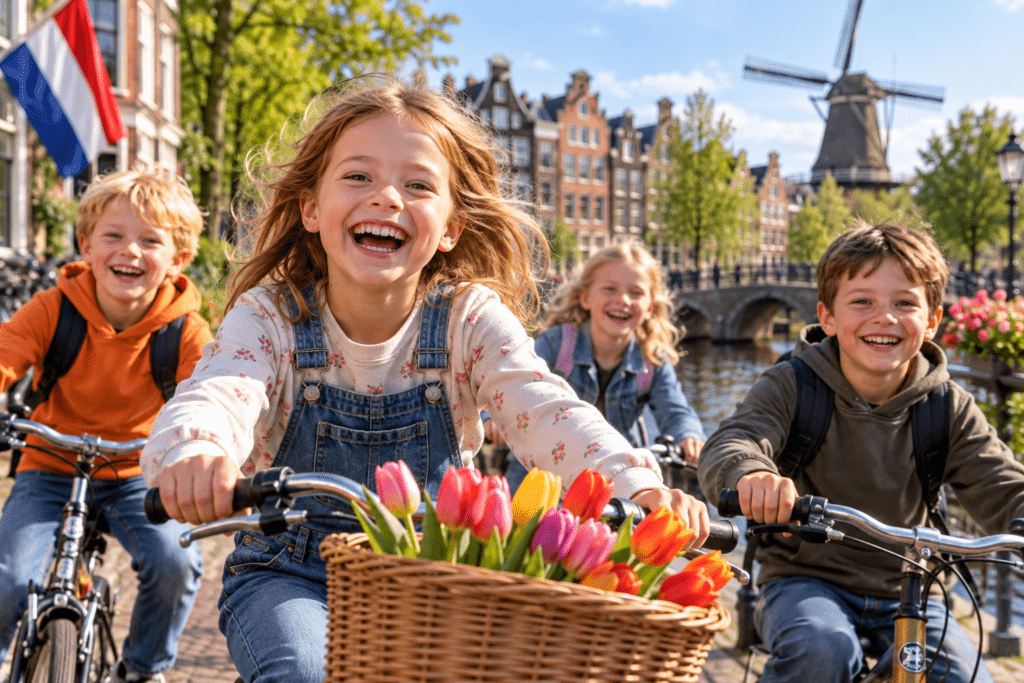
Why Children in the Netherlands Are Smiling Their Way to the Top
Forget endless sunshine, tropical beaches and never having to do your homework.
If you want to find some of the happiest children around, apparently you need bicycles, good friends, a little independence — and perhaps the occasional ride through the rain.
Children in the Netherlands have once again come out on top for wellbeing among the wealthy countries compared by UNICEF.
And while there probably isn’t one secret Dutch ingredient responsible, researchers think several parts of everyday life may be helping.
Friends, Family and Time Together
One of the biggest clues is surprisingly simple: relationships.
Dr Margreet de Looze of Utrecht University told Positive News that Dutch children score particularly highly for the support they receive from family, friends, teachers and classmates.
The Netherlands is also famous for part-time working.
That includes parents, meaning some families are able to spend more time together during the week rather than trying to squeeze family life entirely into evenings and weekends.
It isn’t an option available to every household, of course, but researchers believe that extra time together can be valuable for children.
Freedom on Two Wheels
Then there are the bicycles.
Lots and lots of bicycles.
Dutch towns and cities are designed around cycling to an extent that can seem extraordinary to visitors. Children can start travelling independently at relatively young ages, with cycle infrastructure and streets that often give them considerably more freedom than children growing up somewhere dominated by cars.
A bike isn’t merely a way of getting to school.
For a child, it can mean being able to visit friends, explore the neighbourhood and gradually experience independence without needing Mum or Dad to provide a lift.
Perhaps our picture at the top isn’t so far from the truth after all.
Having a Say
Dutch parenting may play a part too.
Rather than independence meaning parents simply standing back, the approach described to Positive News combines autonomy with involvement.
Children are encouraged to develop opinions, exercise judgement and sometimes participate in decisions and rules that affect them. Cultural education is also used to encourage imagination and give youngsters opportunities to discover their own interests.
In other words, children aren’t simply being prepared for adulthood.
They’re being given some room to be people already.
Not Everything Is Perfect
Of course, even the world’s wellbeing leaders have problems.
Dutch children have not escaped the decline in aspects of childhood wellbeing seen across developed countries since the pandemic. School pressure has increased, poverty remains a reality for some families, and researchers say there is still plenty of work to do.
But perhaps that’s what makes the Netherlands particularly interesting.
There doesn’t appear to be a magical programme making every child happy.
Instead, the picture is made up of lots of comparatively ordinary things.
Time with family.
Good friends.
Supportive schools.
Places to go.
A degree of independence.
And communities where a child can get on a bicycle and begin discovering the world for themselves.
Sometimes improving childhood doesn’t require reinventing childhood.
Sometimes it might simply mean giving children the time, space and freedom to enjoy it.
Read the Original Story & Support Positive News
This Good News story was inspired by reporting from Positive News, the independent publication dedicated to journalism about progress, possibilities and solutions.
We strongly encourage you to read their original reporting:
Read the original Positive News story
Positive News is supported by its readers and uses those contributions to fund its journalism.





Add comment
You must be logged in to post a comment.