

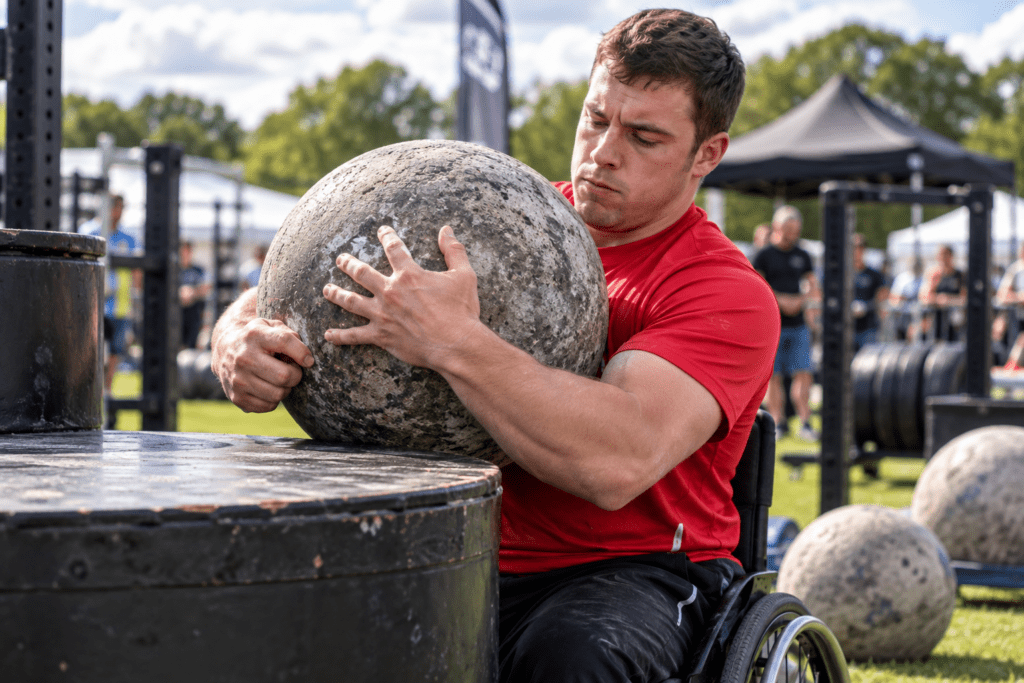
How Conrad Is Building Strength and Confidence with Cerebral Palsy
For 37-year-old Conrad, strength isn’t simply about what happens in the gym. It’s about challenging expectations, maintaining his independence and concentrating on what he can do.
Conrad lives with spastic diplegic cerebral palsy, a condition which primarily affects his legs, balance and mobility. Walking can require considerably more effort, and he sometimes uses a walking stick for additional support. Fatigue, muscle stiffness and uneven ground can all present challenges that aren’t necessarily obvious to the people around him.
But Conrad has never wanted those challenges to determine what he can achieve.
Making a Difference to Others
Conrad works as a Health Advisor for NHS 111 and holds a degree in Health Science.
His working life is centred on helping other people. When someone is worried or unwell, Conrad listens to their concerns, reassures them and helps guide them towards the appropriate care.
It’s a role that gives him the opportunity to make a genuine difference to someone’s day.
Finding His Own Kind of Strength
Sport has long been part of Conrad’s family life. His brother played professional football, but Conrad’s cerebral palsy meant his own sporting journey would take a different direction.
He found it in fitness.
Training helps Conrad maintain his strength and mobility, but its benefits extend far beyond the physical. Fitness has also helped build his confidence, support his mental wellbeing and give him new goals to work towards.
Rather than measuring himself against what somebody else can do, Conrad can concentrate on improving his ownstrength and abilities.
And that’s perhaps what makes his story so powerful.
More Than What People See
Cerebral palsy is often associated with childhood, but children with cerebral palsy grow into adults who continue to live with the condition.
For Conrad, greater awareness of the experiences of adults with cerebral palsy matters — particularly because some of the difficulties he encounters aren’t immediately visible.
Yet those difficulties are only one part of his life.
He’s a university graduate. He’s an NHS 111 Health Advisor. He’s passionate about fitness. And he’s continuing to set himself new goals.
Focus on What You Can Do
The message behind Conrad’s story is wonderfully straightforward: other people’s expectations don’t have to become your limitations.
Challenges may change the route somebody takes, but they don’t necessarily determine the destination.
For Conrad, that means continuing to work, train, improve and concentrate on his strengths rather than allowing cerebral palsy to define him.
And sometimes being strong isn’t about lifting the heaviest weight. It’s about refusing to let somebody else decide how much you’re capable of.







Add comment
You must be logged in to post a comment.