

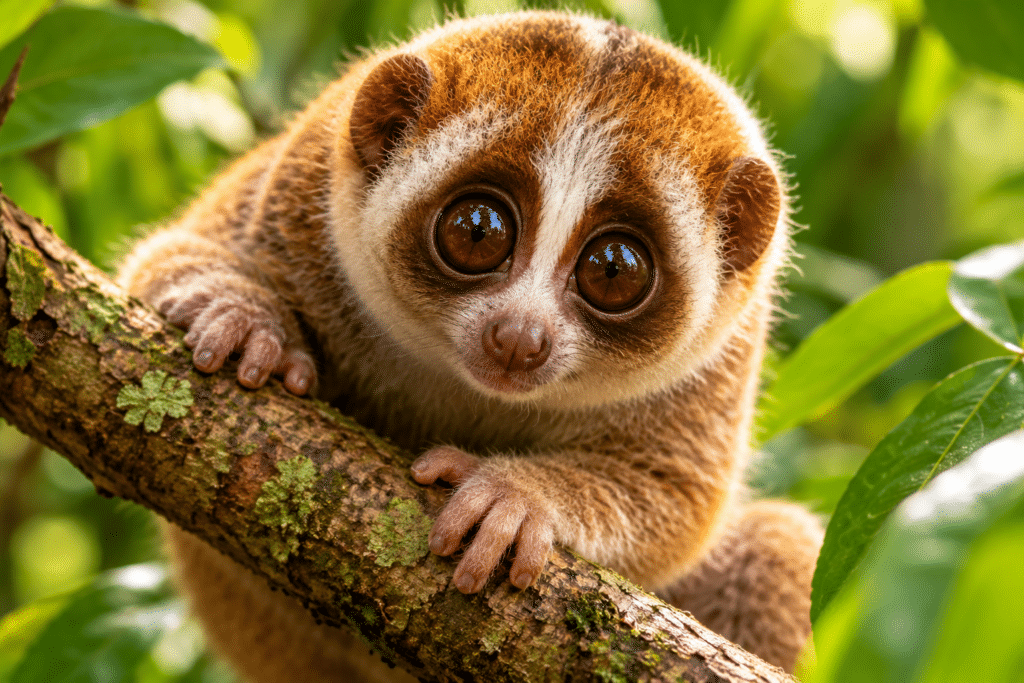
Bangka Slow Loris Shatters 90-Year Game Of Hide-And-Seek
Feared lost for nearly a century, one of the world’s most extraordinary little primates has made a remarkable return to the scientific spotlight — and those enormous eyes are only half the story.
Deep in the tropical forests of Indonesia, a tiny creature with enormous brown eyes, soft reddish fur and an almost impossibly adorable face has delivered some wonderful news to conservationists.
The Bangka slow loris, a critically endangered primate that had virtually disappeared from scientific records since the 1930s, is very much alive.
And rather wonderfully, it turns out that while scientists had been wondering whether the species still existed, local wildlife rescuers had been quietly saving its life for years.
A Century-Long Game of Hide and Seek
The Bangka slow loris (Nycticebus bancanus) lives on the Indonesian island of Bangka, off the coast of Sumatra.
First scientifically described in 1906, this remarkable little animal had gone almost a century without being properly documented in scientific literature.
Its absence was so concerning that the International Union for Conservation of Nature classified it as critically endangered and possibly extinct.
But nobody had told the lorises.
Between 2015 and 2025, the Alobi Wildlife Rescue Center on Bangka encountered more than 90 of the elusive primates.
Some appeared in gardens and residential areas, while others were discovered near roads, plantations and even electrical cables.
Local residents had been reporting the animals to rescuers, who cared for them and, whenever possible, returned them to suitable forest habitats.
Of those rescued, 86 recovered and were released back into the wild.
Now, a newly published scientific study has brought those records together, confirming that the species survives in several parts of the island.
Cute, Cuddly-Looking… and Venomous!
With its enormous eyes, rounded face and gentle movements, the slow loris looks rather like a children’s cuddly toy that has somehow come to life.
But appearances can be deceiving.
Slow lorises are the only primates known to be venomous.
They possess specialised glands near their elbows that produce a secretion which, when mixed with saliva, can turn their bite into a surprisingly effective defence.
In humans, such bites can cause considerable pain, swelling and potentially serious allergic reactions.
So, despite those irresistible eyes, this is definitely one animal best admired from a respectful distance.
Their enormous eyes serve a rather more innocent purpose, helping them navigate the forest after dark.
And despite their name, slow lorises aren’t simply lazy. Their deliberate, almost cautious movements help them travel quietly through the trees without attracting unwanted attention.
A Small Survivor Facing Big Challenges
Although the rediscovery is wonderful news, the Bangka slow loris is not yet out of danger.
Much of its natural habitat has disappeared through illegal tin mining, forest clearance and the expansion of palm oil plantations.
As forests shrink, these nocturnal animals increasingly find themselves crossing roads, entering settlements and encountering electrical infrastructure.
Conservationists now hope the new research will encourage stronger protection for the island’s remaining forests.
They are also calling for population surveys, genetic studies and carefully managed conservation programmes to establish how many Bangka slow lorises remain.
The work of the Alobi Wildlife Rescue Center has already demonstrated just how important local knowledge can be.
While the species had effectively vanished from scientific literature, the people sharing its island home knew it was still there.
A Little Face, A Big Reason to Hope
There is something rather uplifting about an animal feared lost to science making such a remarkable return.
Not through some extraordinary expedition into an unexplored wilderness, but through the patience and dedication of local people who had been rescuing these tiny creatures all along.
The Bangka slow loris still faces an uncertain future, and protecting its remaining habitat will be essential.
But its return to the scientific record offers something conservationists can build upon: evidence that the species has survived, and an opportunity to help it flourish.
And perhaps there’s a lesson in those enormous brown eyes.
Sometimes, even when the world thinks something wonderful has disappeared, it may simply have been quietly waiting to be noticed again.
Loris and behold, indeed!
Source: Re, 20 October 2026 — Bangka Slow Loris Rediscovered After Nearly 100 Years. Research published in the scientific journal Spixiana.








Add comment
You must be logged in to post a comment.