

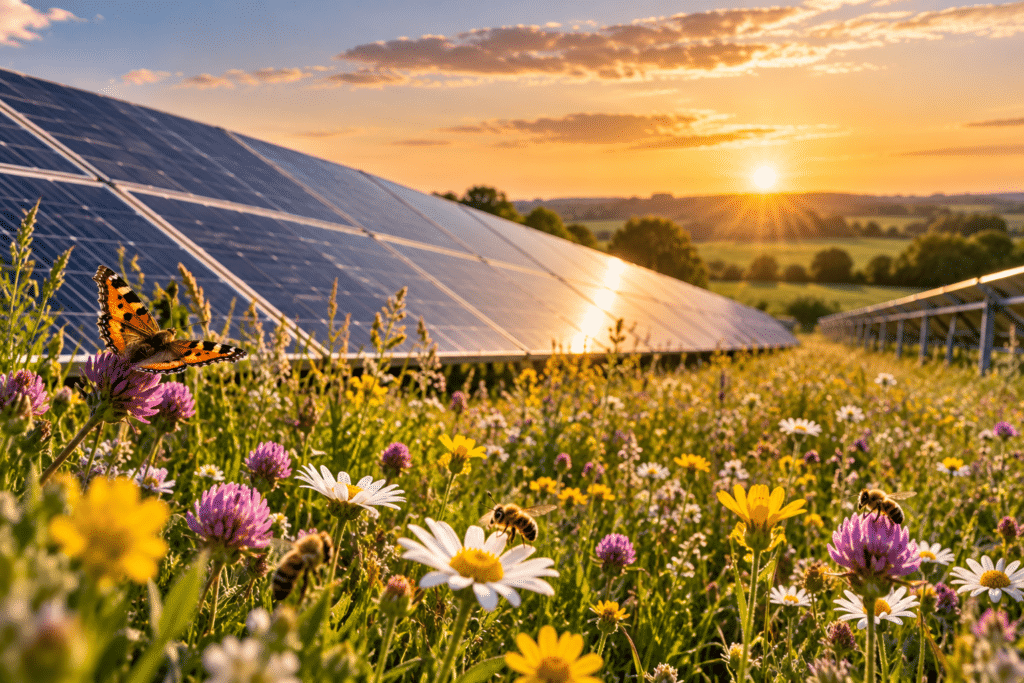
Solar farms are becoming unlikely wildlife sanctuaries as a pioneering British certification scheme puts nature at the heart of renewable energy.
Solar panels soaking up sunshine, butterflies fluttering through wildflowers and birds nesting in nearby hedgerows. It might sound like an unlikely combination, but across Britain, a new approach to renewable energy is proving that generating electricity and protecting wildlife needn’t be competing ambitions.
In fact, they could make rather wonderful neighbours.
A new certification scheme developed by Wild Power is encouraging solar farm operators to go beyond producing clean electricity by transforming the land around their panels into thriving habitats for nature.
And one solar farm in Essex is already showing just how promising that idea could be.
A Brighter Future for Nature
Traditionally, solar farms have been judged primarily on how much electricity they generate. But Wild Power believes the land beneath and between the panels deserves just as much attention.
Its new certification scheme assesses renewable energy developments against biodiversity standards, examining everything from habitat creation and wildlife protection to ecological monitoring and long-term land management.
Developers can use a freely available scorecard to evaluate their sites, with those achieving at least 70 points eligible to apply for independent certification.
So far, two British solar farms have earned the award.
The ambition is straightforward: encourage renewable energy projects to tackle two environmental challenges simultaneously — climate change and biodiversity loss.
Essex Leads the Way
One of the first success stories is Dunmow Solar Farm, a 10-megawatt development in Essex.
The site, co-owned by Thrive Renewables and TopCashback through their Fair Play Clean Energy partnership, became the second British solar farm to receive Wild Power certification in September 2026.
And the ecological ambitions are impressive.
The improvements are projected to deliver a 65% increase in habitat biodiversity units, alongside a 19% improvement in hedgerow biodiversity units.
That’s considerably higher than the 10% biodiversity net gain generally required for qualifying new developments in England.
But the transformation isn’t simply about meeting targets.
Species-rich grassland and wildflower areas have been established, neglected hedgerows repaired, and nesting and roosting boxes installed for birds and bats.
Areas of invasive scrub have also been cleared to improve conditions for breeding skylarks.
The result is a landscape being managed not just for electricity generation, but for the creatures that share it.
A Buzzing New Neighbourhood
Perhaps the most encouraging aspect of the project is how ordinary agricultural land can be given a new ecological purpose.
Where fields were once regularly cultivated, wildflowers and grasses can now develop, providing food and shelter for insects.
Those insects, in turn, can support birds and other wildlife.
The ecological improvements will take time to mature, but early observations are encouraging.
During a visit to the Dunmow site, ecologist Guy Parker described seeing flowering agrimony, butterflies moving among the plants and warblers darting through nearby scrub.
It’s an appealing glimpse of what carefully managed solar farms might become.
And importantly, the solar panels can continue generating electricity throughout the process.
The Potential Is Enormous
Britain’s solar industry is expanding rapidly.
By the end of August 2026, the UK had approximately 23.2 gigawatts of installed solar capacity, with government ambitions to reach 45–47 gigawatts by 2030.
Not all that capacity will come from solar farms, of course. Rooftop installations will also play a significant role.
Nevertheless, the expansion of ground-mounted solar offers an opportunity to improve wildlife habitats across substantial areas of land.
Rather than treating biodiversity as an afterthought, developers could incorporate wildflower meadows, habitat corridors and wildlife-friendly management into projects from the beginning.
And because solar farms can operate for decades, those improvements could provide lasting benefits.
Let Nature Do Its Thing
There is one important qualification.
The projected biodiversity improvements at Dunmow have not yet been fully realised.
Wildflowers need time to establish, habitats must mature, and wildlife populations need to be monitored to determine whether the changes are delivering their intended benefits.
Annual ecological surveys will assess breeding birds, pollinators and grassland species.
Certification recognises the measures being introduced, but long-term monitoring will establish how successful they actually are.
That distinction matters.
Nevertheless, the early signs offer genuine reasons for optimism.
A Little More Sunshine
The beauty of this initiative is that it doesn’t ask us to choose between renewable energy and the natural world.
Instead, it challenges developers to consider how both might flourish together.
A field of solar panels needn’t be an ecological wasteland. With thoughtful planning and management, it could become a meadow alive with bees, butterflies, birds and wildflowers.
Clean electricity above, thriving wildlife below.
Now that’s what we call a bright idea!
Source: Positive News — Robin Eveleigh, 20 October 2026.
The new certification scheme helping solar farms become havens for wildlife
This article is an independently written summary and adaptation of reporting by Positive News. Biodiversity improvements described as projections remain subject to ecological monitoring.







Add comment
You must be logged in to post a comment.