

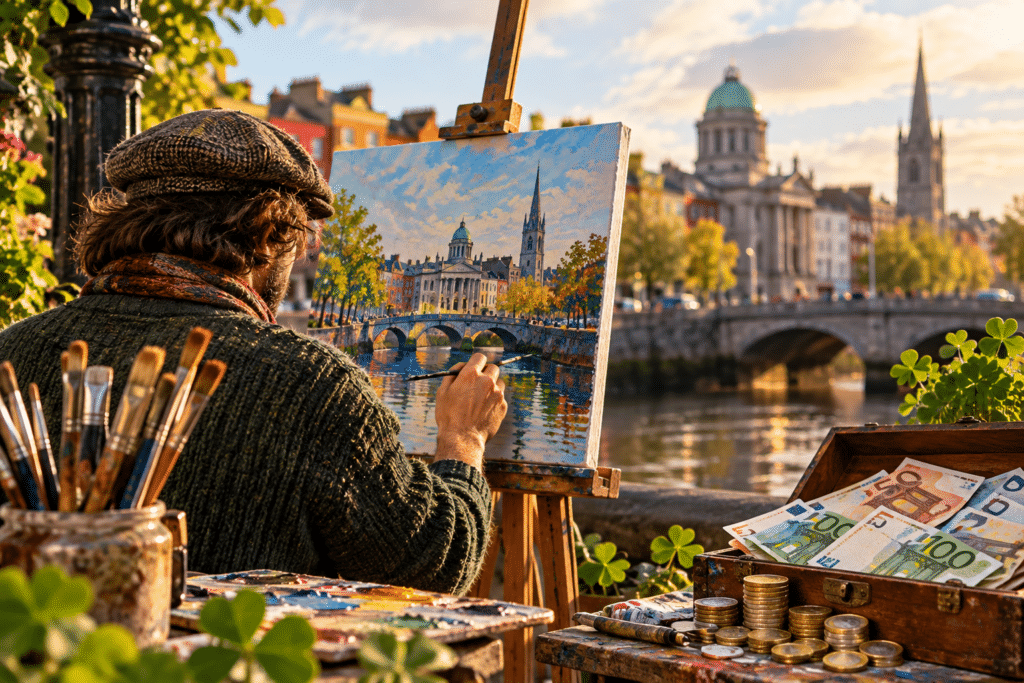
Ireland is proving that creativity really does pay.
As its pioneering Basic Income for the Arts scheme gives thousands of artists something almost as valuable as inspiration itself: financial security.
For generations, the image of the struggling artist has been almost as familiar as the masterpieces they create. Long hours, uncertain earnings and the constant pressure of paying the bills have forced countless talented people to choose between their passion and their livelihood.
But Ireland has decided that artistic talent deserves more than applause.
Through its groundbreaking Basic Income for the Arts programme, the Irish government is providing eligible creative professionals with €325 a week, allowing them to spend more time doing what they do best: creating.
And with renewed financial backing, the initiative is moving from an ambitious experiment towards becoming a permanent part of Ireland’s cultural landscape.
A Masterpiece of an Idea
Originally introduced as a pilot programme in 2022, the scheme was designed to investigate what happens when artists are given a reliable income without having to constantly chase their next commission, performance or sale.
The answer has been encouraging.
Research into the programme has found that financial security can help artists devote more time to creative work, reduce financial stress and improve their ability to sustain a career in the arts.
Rather than replacing artistic ambition, the payments have helped give creativity room to flourish.
For painters, musicians, writers, performers and other creative professionals, that breathing space can make an enormous difference.
After all, inspiration rarely arrives conveniently between shifts at a second job.
Putting Money Where the Art Is
Ireland’s commitment is continuing.
With €34.4 million allocated for 2027, the government is supporting the next stage of the programme, which is intended to provide 2,000 selected artists with weekly payments of €325.
The permanent scheme is designed around three-year funding cycles, giving successful participants a greater degree of certainty as they develop their work.
It is an investment not simply in individual artists, but in the wider cultural life of the country.
From music and literature to theatre, visual art and performance, Ireland’s creative industries contribute to national identity, local communities and the economy.
And while not every painting will become a masterpiece or every song a chart-topper, the opportunity to create without overwhelming financial pressure could help nurture the next generation of extraordinary talent.
More Than Just a Pretty Picture
Perhaps the most interesting aspect of Ireland’s experiment is the idea behind it.
Art is often treated as something society enjoys once the serious business of economics has been taken care of.
Yet creativity helps shape the places we live, the stories we tell and the way we understand the world.
Ireland’s approach recognises that the people producing that creativity need time, stability and opportunity, just like professionals in any other field.
It also raises an intriguing question for other countries: could providing artists with a modest financial foundation ultimately produce greater cultural and economic benefits than leaving them to struggle?
Ireland is helping to provide some answers.
A Brighter Canvas for the Future
There is something wonderfully optimistic about a country choosing to invest in imagination.
Not every artist will become a Picasso, and no government can guarantee the next great novel, musical composition or theatrical triumph.
But by giving creative people a better chance to develop their talents, Ireland is demonstrating that the arts are worth supporting before success arrives, rather than celebrating them only afterwards.
And for thousands of artists hoping to turn inspiration into a sustainable career, that could be the most valuable masterpiece of all.
Because sometimes, the best way to create something extraordinary is simply to give someone the freedom to try.





Add comment
You must be logged in to post a comment.