

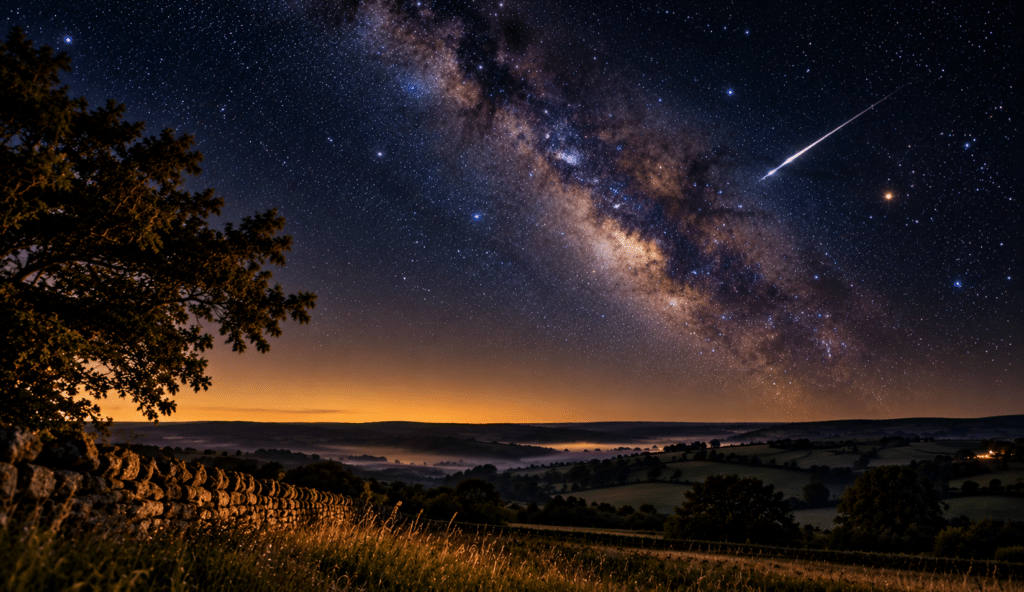
Who needs to wait until Guy Fawkes Night for fireworks? The universe is getting the celebrations started early, with seven meteor showers lighting up October’s skies. No rockets, no Catherine wheels, no noisy neighbours.
Nature putting on a spectacular celestial display. And best of all?
It’s completely free.
For most of the year, the night sky quietly goes about its business. Stars twinkle, planets wander and the occasional shooting star flashes past before anyone has time to make a wish.
But October is rather different.
This month, Earth is travelling through several streams of cosmic debris, creating a succession of meteor showers that promise to give stargazers plenty of reasons to venture outdoors after dark.
And despite their popular name, shooting stars aren’t stars at all.
They’re tiny fragments of rock and dust, often left behind by comets, travelling through space until they encounter Earth’s atmosphere. Moving at extraordinary speeds, these particles heat the surrounding air as they plunge towards our planet, producing the brilliant streaks of light we call meteors.
Most are no bigger than grains of sand.
Yet their brief appearance can illuminate the darkness in spectacular fashion.
Seven Reasons to Look Up
October’s celestial programme features seven meteor showers, although some are considerably more active than others.
The Draconids are among the first to take centre stage, with activity concentrated around the beginning of October. Unlike many meteor showers, which are best observed in the early hours, the Draconids can offer opportunities for evening viewing.
Then come the Orionids, one of the month’s best-known displays.
These meteors originate from debris left behind by Halley’s Comet, the famous celestial visitor that returns to the inner Solar System roughly every 76 years.
Although the comet itself won’t return until 2061, Earth encounters particles from its ancient trail every October.
The Orionids are expected to reach their peak around 21–22 October, with fast-moving meteors streaking across the sky.
Other showers contributing to the month’s activity include the Southern and Leonis Minorids, the October Camelopardalids, the Delta Aurigids and the Epsilon Geminids.
Not every shower will produce a dramatic display, and some may offer only a handful of meteors under ideal conditions. Nevertheless, together they make October a particularly interesting month for anyone fascinated by the night sky.
A Front-Row Seat in the Countryside
There’s no need for an expensive telescope, specialist equipment or even a pair of binoculars.
In fact, the best instrument for watching a meteor shower is something everyone already possesses: their eyes.
The trick is finding somewhere dark.
Streetlights, illuminated buildings and the glow from towns and cities can obscure all but the brightest meteors. Head into the countryside, away from artificial lighting, and the difference can be remarkable.
Allow around 20–30 minutes for your eyes to adjust to the darkness, dress warmly and find somewhere comfortable with a wide view of the sky.
A little patience helps, too.
Meteor showers are unpredictable. Several minutes might pass without a single flash, only for a brilliant streak to suddenly appear overhead.
And while astronomers can predict when Earth will encounter a particular stream of debris, nobody can tell you precisely when or where the next meteor will appear.
That’s part of the magic.
The Universe Hasn’t Finished Surprising Us
For all our technological achievements, there’s something wonderfully humbling about standing beneath a dark sky and watching a fragment of ancient cosmic material burn brightly for a fleeting moment.
Some of those particles have been travelling around the Sun for centuries, long before the invention of the motor car, television or mobile telephone.
And now, for a fraction of a second, they become visible to someone standing in a field, a garden or a quiet country lane.
So, if the clouds cooperate this October, wrap up warm, find somewhere dark and take a moment to look upwards.
You might just catch a shooting star.
And if you do, there’s always time to make a wish.








Add comment
You must be logged in to post a comment.