

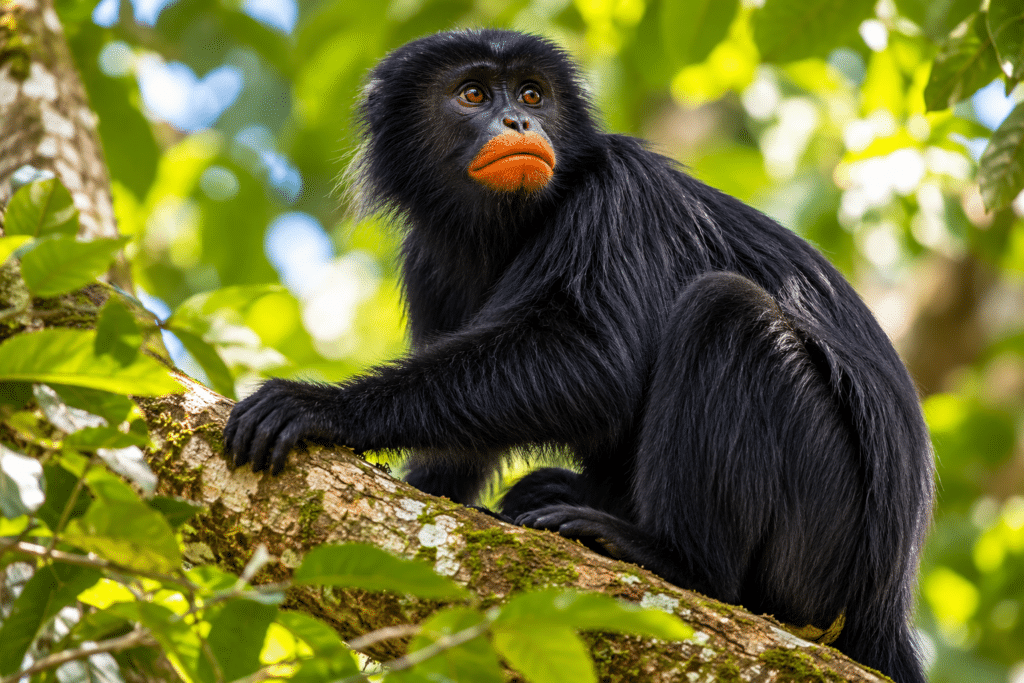
Meet likweli — the extraordinary orange-lipped monkey that has just been recognised as a new species
Just when you think we must have discovered everything by now, nature has a habit of reminding us just how much is still out there.
Deep in the forests of the Democratic Republic of the Congo, scientists have formally described a remarkable new species of monkey — and it is certainly not difficult to pick out of a crowd.
Meet Colobus congoensis, known locally as likweli.
With silky black fur, a long tail and extraordinarily bright orange lips, likweli looks as though someone has applied a particularly enthusiastic shade of lipstick before sending it into the rainforest.
But its appearance isn’t the only thing that makes this discovery special.
Likweli is only the fifth new African monkey species to be described in the past 75 years.
It started with a blurry photograph
The story began back in 2008, when researchers saw a photograph of an unusual monkey from a remote part of the Congo Basin.
The picture wasn’t exactly studio quality, but there was enough in it to raise an intriguing question: what exactly were they looking at?
Another sighting followed in 2018.
That was enough to warrant a proper investigation.
Researchers headed into what is now Lomami National Park and the surrounding forests to find out whether the mysterious orange-lipped monkey really was something different.
Over the following four years, they recorded 114 sightings across an area of around 1,700 square kilometres.
And the evidence began piling up.
Scientists studied the monkeys’ appearance, genetics and even their voices. Likweli produces a distinctive, powerful call that helped researchers distinguish it from related colobus monkeys.
Eventually, the evidence pointed to an extraordinary conclusion.
This wasn’t simply an unusual population of a species we already knew.
It was a species of its own.
Who’s watching whom?
Perhaps the loveliest part of the story is what happened when researchers actually encountered the monkeys.
Rather than immediately disappearing into the forest, likweli would often climb higher into the canopy and stare down at the scientists below.
Researcher Kate Detwiler described the encounters as almost feeling as though the monkeys were studying the humans at the same time the humans were studying them.
Which seems perfectly reasonable.
After all, from the monkey’s point of view, a group of people wandering around the forest carrying notebooks and staring upwards probably looks pretty peculiar too.
Discovered — now protected
There is, however, an important reason why identifying likweli matters.
The species appears to have a relatively restricted range and a small population, while hunting and habitat loss remain threats. Researchers have therefore recommended that it should be considered Endangered.
Giving the monkey its own scientific identity means conservationists can properly recognise it, study it and work to protect the forests on which it depends.
And that makes this much more than simply adding another name to a biology textbook.
More than a century after explorers began systematically documenting the wildlife of Central Africa, an entire species of primate was still living in the forest waiting for science to catch up.
Black fur.
Orange lips.
One enormous voice.
And one more reminder that our planet still has a few surprises left.
Welcome to the world, likweli. We may have only just found you — but we’re very glad we did.








Add comment
You must be logged in to post a comment.