

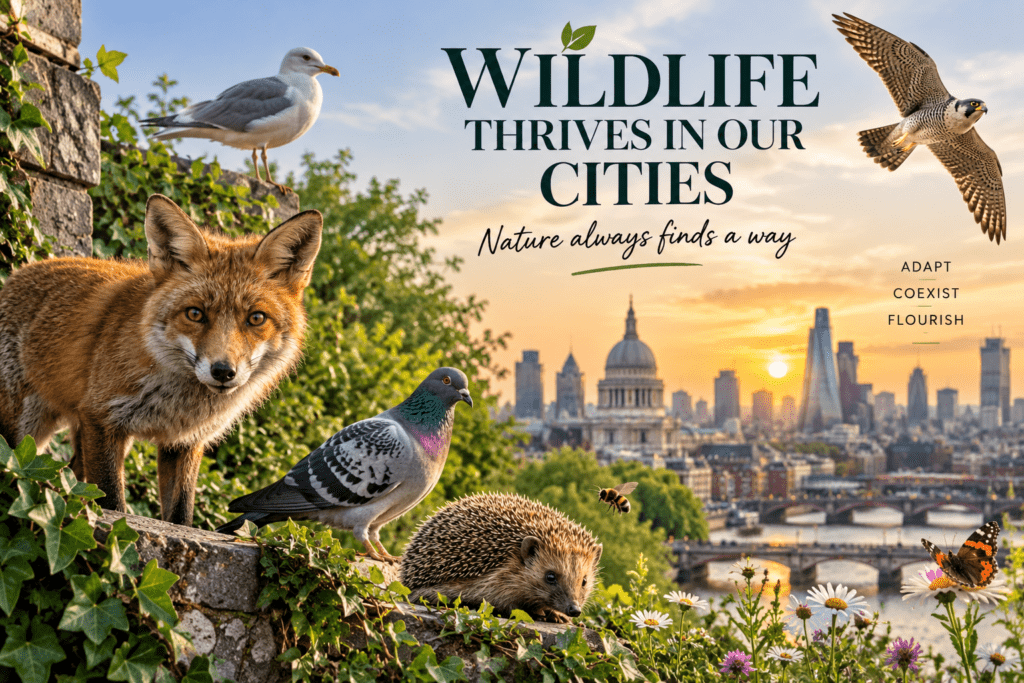
From foxes and falcons to bees, butterflies and unexpected pockets of greenery, wildlife is learning to thrive in the concrete jungle.
For decades, the growth of our cities has been regarded almost entirely as bad news for wildlife. Concrete replaces grassland, roads divide habitats and buildings consume the spaces where plants and animals once flourished.
But nature, it seems, has other ideas.
Across the world, scientists are discovering that cities can support a surprising variety of wildlife. Some species are not merely surviving alongside millions of people — they are adapting remarkably well to their new urban surroundings.
Research highlighted by UNESCO shows how animals and plants are finding ingenious ways to make themselves at home among our streets, buildings, parks and gardens.
Urban foxes have become a familiar sight in British towns and cities, while peregrine falcons have discovered that tall buildings can provide substitutes for the cliffs on which they traditionally nest. Parakeets have established thriving populations in cities including London, Brussels and Amsterdam, while bats and other species have turned buildings and industrial structures into valuable habitat.
Even plants are adapting.
Researchers studying urban environments have found examples of plants changing the way they reproduce in response to the fragmented patches of soil available between expanses of concrete. Birds, meanwhile, can alter their behaviour to cope with city noise and take advantage of new sources of food.
It is an extraordinary demonstration of nature’s ability to adapt.
But the encouraging story isn’t simply that wildlife is becoming better at living with us. We are also becoming better at designing cities in which wildlife has a place.
Green roofs, wildflower verges, urban forests, ponds and wildlife corridors can transform otherwise sterile areas into useful habitats. Even relatively small patches of vegetation can provide food and shelter for insects, birds and other animals.
Connecting those individual patches is particularly important. A collection of isolated parks can help wildlife, but networks of gardens, waterways, trees and green corridors allow species to move through an urban landscape rather than becoming trapped in small pockets.
Cities around the world are beginning to recognise the opportunity.
UNESCO points to places including Melbourne, Singapore and Cape Town, where biodiversity is increasingly being considered as part of urban life. The objective isn’t to somehow return enormous modern cities to untouched wilderness. It is to create places where people and nature can coexist.
And that can benefit humans too.
Trees provide shade and help moderate extreme urban temperatures. Vegetation can improve air quality and absorb rainwater. Green spaces give people somewhere to exercise, relax and escape the relentless noise and movement of city life.
Perhaps most importantly, they provide millions of people with an everyday connection to the natural world.
There is still plenty of reason for concern. Urban expansion remains a major threat to biodiversity worldwide, and the remarkable adaptability of certain species cannot compensate for the habitats being lost elsewhere.
Nor does every species cope equally well with city life. The animals we see flourishing around us tend to be those capable of adapting quickly, while more specialised species can disappear when their particular habitats are destroyed.
That makes thoughtful urban planning all the more important.
The encouraging discovery is that concrete and wildlife don’t have to be mutually exclusive.
Leave room for wildflowers and insects arrive. Plant trees and birds follow. Connect green spaces and animals gain routes through landscapes that might otherwise be impassable.
Sometimes wildlife even finds opportunities we never intended to provide.
A ledge becomes a cliff.
A railway embankment becomes a meadow.
A rooftop becomes a garden.
And a city built almost entirely for humans becomes home to something considerably wilder.
Nature, after all, has had several billion years to practise adapting. It isn’t giving up on our cities without a fight.





Add comment
You must be logged in to post a comment.