

Scientists discover that a simple touch could bring dying coral back to life in
just seven weeks!
It sounds almost too good to be true. A coral reef turns ghostly white, its living inhabitants begin to starve, and the outlook appears desperately bleak.
Then along comes a healthy neighbour, gives it a helping hand — or rather, a helping branch — and something extraordinary happens.
The bleached coral begins to recover!
Scientists at Stanford University in California have discovered that bleached corals can return to full health in just seven weeks after coming into contact with healthy, genetically identical corals.
And the remarkable discovery could offer fresh hope for some of the world’s most threatened underwater ecosystems.
A Touch of Underwater Magic
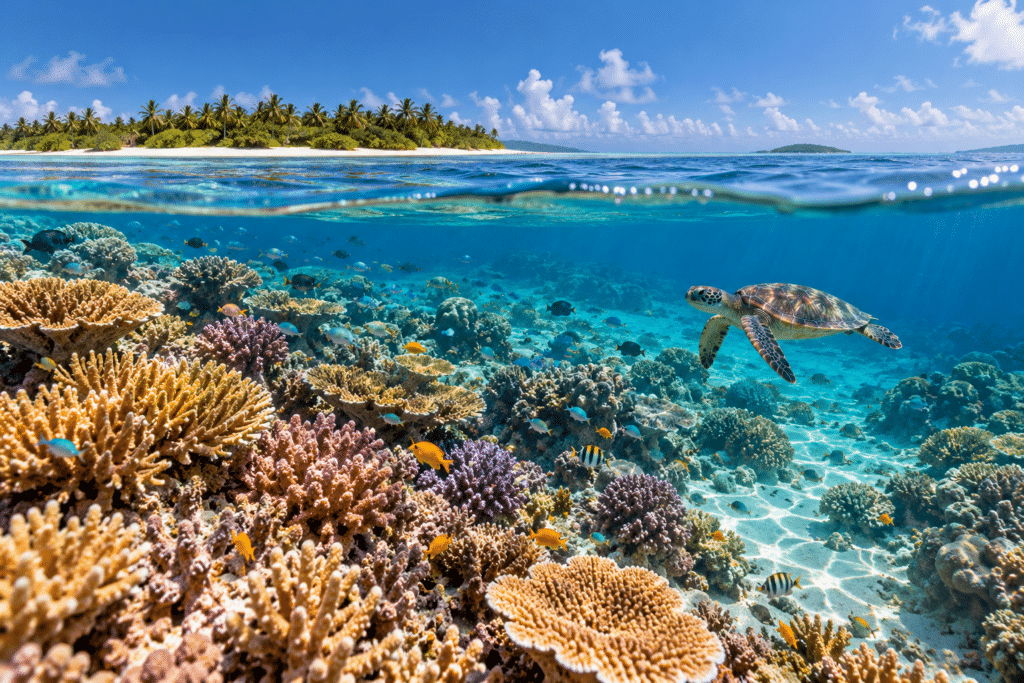
Coral reefs are among the most spectacular and important habitats on Earth, supporting an astonishing variety of marine life.
But rising ocean temperatures are placing them under enormous pressure.
When seawater becomes too warm, corals can expel the microscopic algae living inside their tissues. These algae provide much of the energy corals need to survive and give them their vibrant colours.
Without them, corals turn white in a process known as coral bleaching.
And although bleached coral isn’t necessarily dead, it can take months or even years to recover — if it survives at all.
That is what makes this new discovery so exciting.
The Accidental Discovery That Changed Everything
The breakthrough began with a happy accident in 2025.
Marine scientist Professor Steve Palumbi noticed something unusual in a laboratory tank.
Two fragments of coral from the same colony had fallen against one another. One was healthy, while the other had been bleached.
But where the two fragments touched, colour was beginning to return to the damaged coral.
Rather than dismissing the observation, researchers decided to investigate.
Led by Stanford doctoral researcher Danny Collins, the team arranged ten pairs of coral fragments, each containing one healthy piece and one bleached piece.
Five pairs were placed in direct contact. The remaining five were separated by just a few millimetres.
The results were extraordinary.
All five bleached fragments touching their healthy counterparts recovered within seven weeks.
Those kept apart failed to recover and eventually died.
Three Days to Start a Recovery
Using powerful microscopes, researchers discovered how the rescue worked.
When genetically identical coral fragments touch, their living tissues can fuse, creating tiny pathways between them.
Through these connections, beneficial algae and nutrients travel from the healthy coral into its struggling neighbour.
Scientists observed the algae entering bleached coral within just three days.
Even more remarkably, some coral fragments needed only five to seven days of contact before they could continue recovering independently.
Once inside, the algae multiplied rapidly, helping the coral regain its colour and vitality.
It was as though the healthy coral had supplied the biological equivalent of a jump-start.
Could This Save the World’s Reefs?
There is an important catch.
The experiments took place in laboratory tanks, and the successful transfers required healthy coral fragments with the same genetic makeup as their bleached partners.
Finding a healthy, genetically identical donor for every damaged coral across the world’s reefs simply isn’t practical.
But scientists believe the discovery could lead to something much bigger.
By understanding how healthy corals transfer their beneficial algae, researchers hope to develop new ways of delivering those algae directly to damaged reefs.
That could eventually help corals recover more quickly following marine heatwaves.
There is still considerable work to do, and the technique is not yet a solution for restoring entire reefs.
Nevertheless, it represents an encouraging step forward in the battle to protect these extraordinary ecosystems.
A Brighter Future Beneath the Waves
Coral reefs shelter countless marine creatures, support coastal communities and help protect shorelines from storms.
Their survival matters far beyond the beautiful tropical waters in which they grow.
For years, headlines about coral bleaching have painted an increasingly worrying picture.
Now, thanks to an accidental encounter in a laboratory tank and some determined scientific detective work, there is a new reason for optimism.
Sometimes, the smallest discoveries can open the door to enormous possibilities.
And in this case, a little contact between neighbours might help give our planet’s coral reefs a fighting chance.
Now that’s what we call Reef Relief!
Source: Stanford University, Stanford Doerr School of Sustainability, 14 October 2026. Research published in Science Advances.








Add comment
You must be logged in to post a comment.