

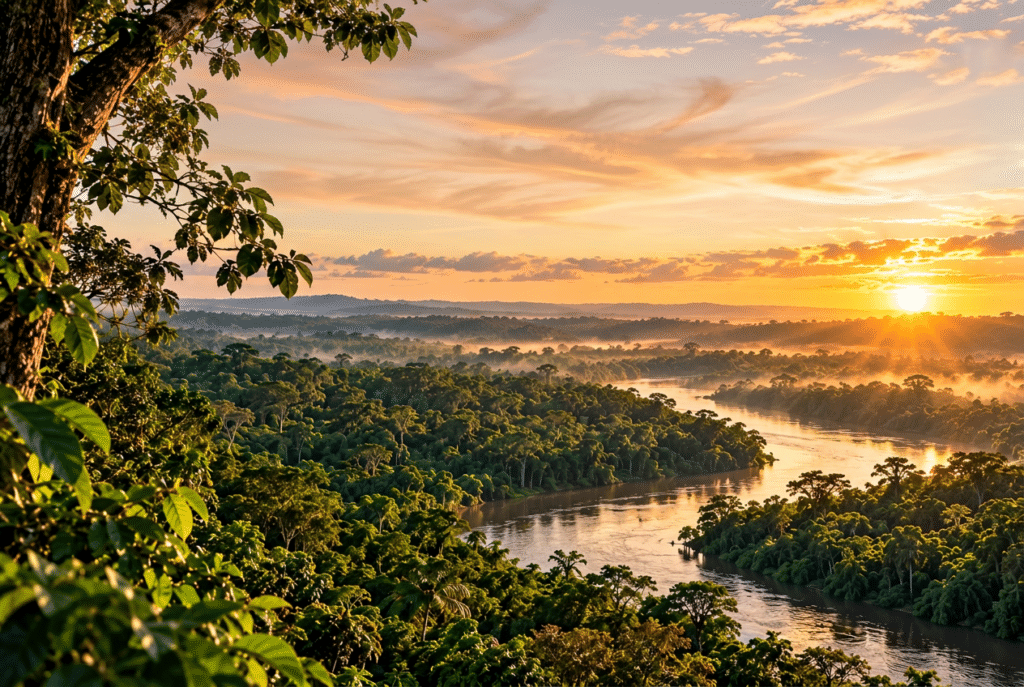
Brazil has delivered some genuinely encouraging news from the world’s largest rainforest.
Amazon deforestation alerts falling by an extraordinary 36% in just one year.
New satellite data from Brazil’s National Institute for Space Research (INPE) shows that 2,874 square kilometres of the Amazon were covered by deforestation alerts between August 2025 and July 2026.
That is still an enormous area of precious forest. But the direction of travel is something worth celebrating.
The figure is 36% lower than the previous year and an impressive 55.6% below the average recorded over the previous decade.
Better still, it is the lowest figure in the current DETER monitoring series.
A forest fighting back
Brazil’s Amazon is home to an astonishing variety of wildlife, plants and communities, while its vast forests play an important role in storing carbon and regulating the climate.
For decades, however, huge areas have been lost to activities including agriculture, mining and illegal logging.
That makes the latest numbers particularly significant.
The DETER satellite system is designed to spot areas of forest loss quickly, allowing authorities to identify potential deforestation and direct enforcement teams to where they are needed.
And the improvement isn’t confined to one corner of the Amazon.
Deforestation alerts fell by 49% in Mato Grosso, 46.7% in Amazonas, 41.2% in Rondônia, 35.3% in Acre and 25.5% in Pará compared with the previous monitoring period.
Roraima bucked the trend, however, recording an increase of 32.5% — an important reminder that the battle is far from won.
More good news beyond the Amazon
There were encouraging signs elsewhere in Brazil too.
In the Cerrado — one of the world’s most biodiverse savannahs — deforestation alerts fell by 7.8%, reaching their lowest level in five years.
Separately, Brazil’s more detailed annual PRODES monitoring recorded substantial reductions in forest and vegetation loss in several other biomes, including falls of 34.3% in the Caatinga, 15.3% in the Atlantic Forest and 41.7% in the Pampa.
Still plenty of work to do
There is an important caveat.
DETER provides rapid satellite alerts to help authorities tackle deforestation as it happens. Brazil’s PRODES system uses more detailed mapping to calculate the country’s official annual deforestation rate.
So these latest figures don’t mean deforestation has disappeared — and threats including fires, drought, logging and forest degradation remain.
But they do show something important.
Rainforest destruction isn’t inevitable.
Thousands of square kilometres of Amazon rainforest that might once have been expected to disappear are instead contributing to a rapidly falling trend in forest loss.
For one of the most important ecosystems on Earth, that’s very good news indeed.
The Amazon isn’t out of the woods yet — but considerably more of the woods are still standing.







Add comment
You must be logged in to post a comment.