

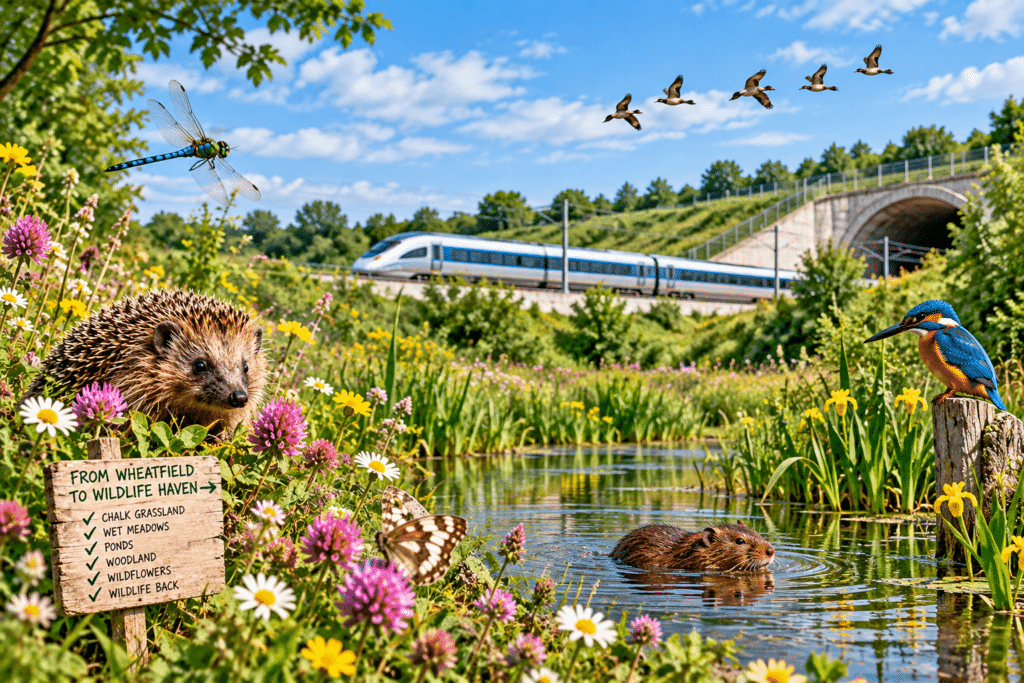
HS2 may have had its delays — but nature certainly hasn’t.
A former wheatfield beside Britain’s high-speed railway project has undergone an extraordinary transformation, becoming a thriving new haven for wildlife in just four years.
The 127-hectare Western Slopes site in the Colne Valley, close to the entrance of HS2’s Chilterns tunnel, was once intensively farmed land with relatively little biodiversity.
Today, it is alive with wildflowers, butterflies, birds, dragonflies and mammals — including some particularly unexpected arrivals.
Perhaps the most remarkable is hedgehog clover, a small native wildflower that had not been recorded in Hertfordshire since 1878.
More than a century later, it has returned.
And it isn’t alone.
Water voles have discovered the newly created habitat, kingfishers are increasing in number, while skylarks and little ringed plovers have moved onto the site. Pyramidal orchids, marbled white butterflies and lesser emperor dragonflies are among the other species now making themselves at home.
The transformation began with an unusual question.
When ecologist Matt Hobbs discovered that enormous quantities of chalk would be excavated while boring the 10-mile Chilterns tunnel, he saw an opportunity to use the material rather than simply treat it as waste.
Millions of tonnes of excavated chalk were kept on site and used to create the rolling, nutrient-poor landscape needed for chalk grassland — one of Britain’s richest but increasingly scarce wildlife habitats.
The result is a new landscape of chalk grassland, wet meadows, ponds, woodland and scrub.
Almost 65,000 trees and shrubs representing 32 species are also being planted, alongside around 3.5 kilometres of new hedgerow.
Down beside the River Colne, nearly five hectares of newly created wetlands have already been colonised by plants including water mint and club-rush, while reed warblers are breeding there and water voles have appeared in a tributary.
There are even specially designed routes beneath the railway to allow animals including badgers and stoats to cross safely.
And the transformation can apparently be heard as well as seen.
Despite the M25 and construction work nearby, parts of the site that were once dominated by machinery are now filled with birdsong and the hum of insects.
Some footpaths through the new landscape are expected to open to the public within the next 18 months, although areas important to ground-nesting birds are likely to remain protected.
HS2 may be best known for rails, tunnels and engineering.
But in one corner of Hertfordshire, something rather less expected has been under construction.
A home for the wild.







Add comment
You must be logged in to post a comment.